EthanHu
Yichen Hu
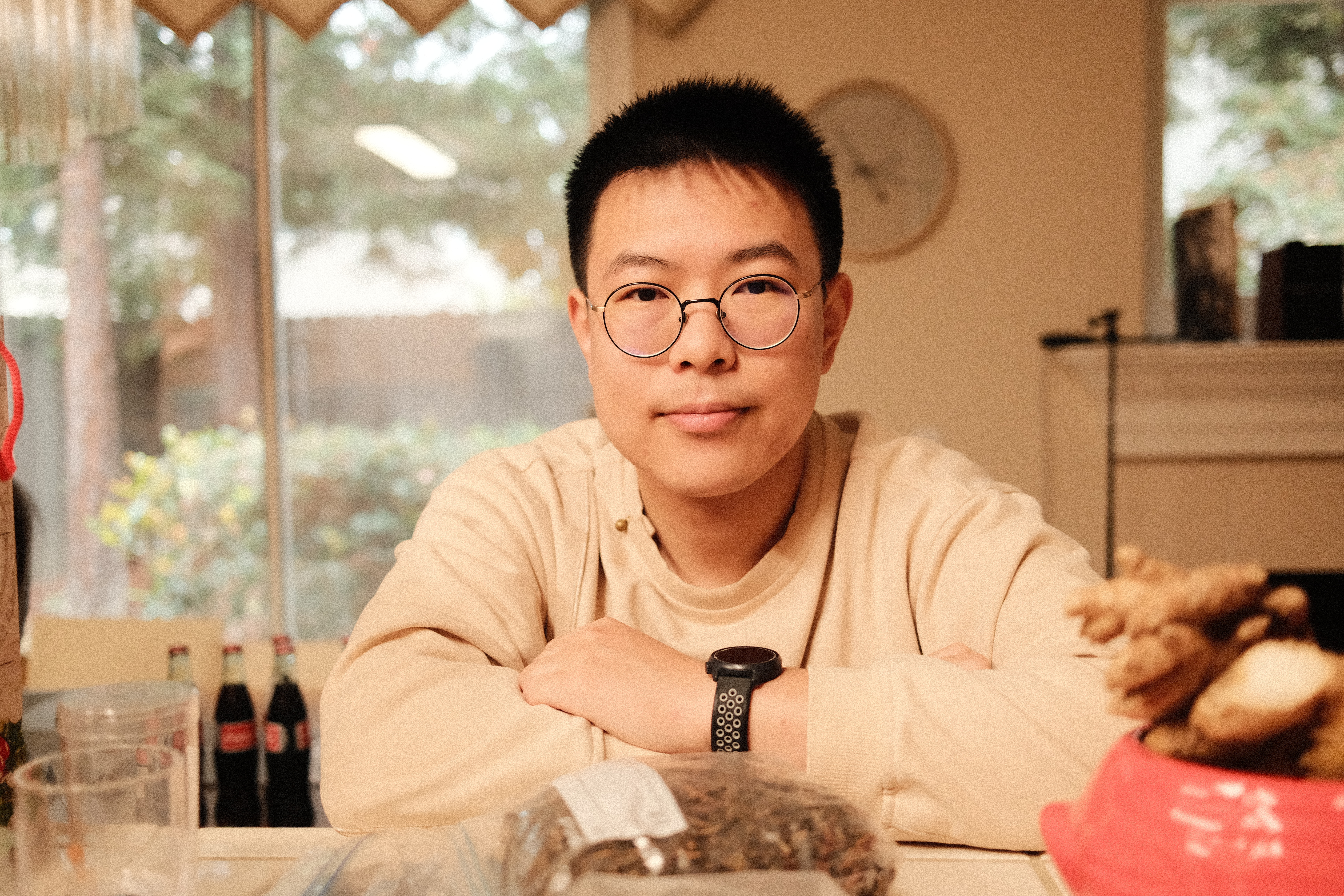
Biography
I am Yichen Hu, a Ph.D. candidate in the Department of Statistics at the University of California, Davis, under the supervision of Dr. Xiucai Ding. My research focuses on high‑dimensional statistics, graph networks, manifold learning and random matrix theory. You can reach me at ethhu@ucdavis.edu and my publication can be found at Google scholar.
Education
| Degree | Institution | Dates |
|---|---|---|
| B.Sc. in Statistics | Shanghai University of Finance and Economics | 2016 – 2020 |
| M.Sc. in Statistics | University of California, Davis | 2021 – 2023 |
| Ph.D. in Statistics (in progress) | University of California, Davis | 2023 – present |
Research Interests
My work explores various areas of high‑dimensional statistics and probability theory, including:
- Random graphs and network models
- Manifold learning
- Random matrix theory
and their applications to modern data science and machine learning.
Publications
Ding, X., & Hu, Y. (2025). On the edge eigenvalues of sparse random geometric graphs.
We investigate the edge eigenvalues of random geometric graphs (RGGs) generated by multivariate Gaussian samples in a sparse regime under a broad class of distance metrics. Traditional approaches based on integral operators or min–max principles typically require dense graphs or distributions with compact support, so they cannot handle unbounded and vanishing densities. We introduce a two‑step smoothing–matching argument: first construct a smoothed empirical operator from the graph, and then match its edge eigenvalues to those of a continuum limit operator using a counting argument. After proper normalization, we prove that the first few nontrivial edge eigenvalues converge with high probability to those of a weighted Laplace–Beltrami operator that can be computed from a simple second‑order partial differential equation.
Ding, X., Hu, Y., & Wang, Z. (2025). Two sample test for covariance matrices in ultra‑high dimension. Journal of the American Statistical Association
We propose a new method to test whether two populations have the same covariance matrix when the dimension is much larger than the sample sizes. The procedure implement a bootstrap-like resampling of samples and splits each dataset into two parts to compute a novel statistic. Unlike previous tests, our method does not assume comparable sample sizes or specific structures in the covariance matrices and does not require parametric distributions or knowledge of the populations’ moments. We derive the asymptotic distribution of our statistic and conduct power analysis, showing that the test remains powerful under very weak alternatives. Extensive simulations and analyses of two real datasets illustrate the superior performance of our approach. An open‑source R package, UHDtst, implements the method.